Who is responsible if the hazard warning lights on the towed vehicle are not switched on?
RTR 216. A vehicle being towed or carried, whose front or rear section rests on a supporting device, must have its hazard warning lights on at all times of day. If hazard warning lights are not fitted or are defective, a warning triangle must be attached to the rear of the towed vehicle or to the part of the carried vehicle facing opposite to the direction of travel so that it is visible to other road users. RTR 218. The driver of the towing vehicle is responsible for ensuring compliance with the requirements of this Chapter.
1. The driver of the towed vehicle.
2. The owner of the towing vehicle.
3. The driver of the towing vehicle.
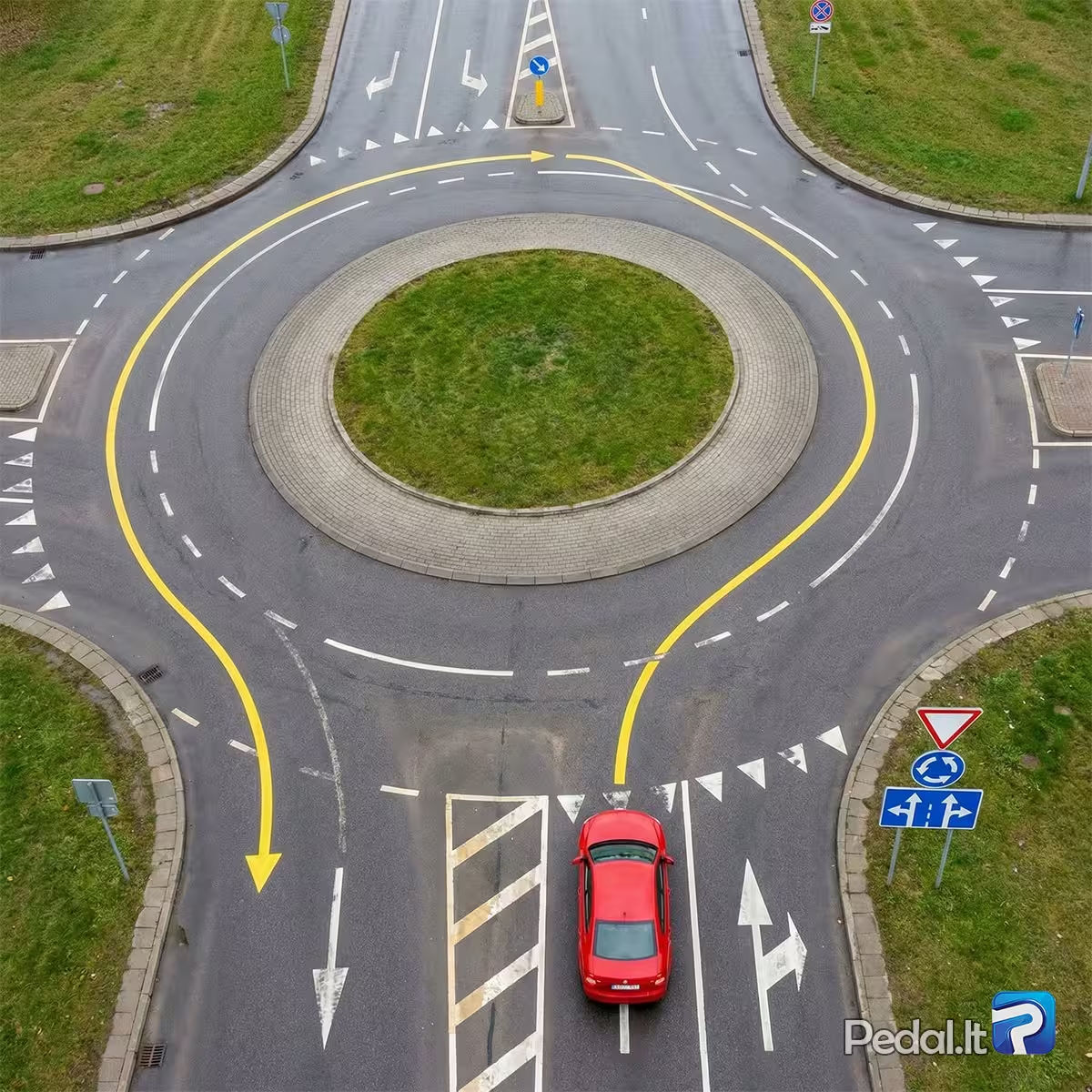
Is the red vehicle permitted to manoeuvre in this way in a turbo roundabout?
There is no sign before the third exit requiring the driver to leave the roundabout. Furthermore, the intersection's design allows the driver to position the vehicle for the fourth exit; therefore, the driver is permitted to perform this manoeuvre.
1. The red vehicle is permitted to manoeuvre in this manner.
2. The red vehicle is not permitted to manoeuvre in this manner.
Factors that influence safe driving:
Driver's experience and skills strongly influence safe driving. Greater experience generally leads to safer driving. The condition of the road surface also affects safety: slippery, dirty, or gravel-covered surfaces are considerably more hazardous, especially when cornering. 127. Drivers must not exceed the permitted speed limit. Drivers must select a speed appropriate to driving conditions — particularly the terrain, the condition of the road and the vehicle (including its load), weather, and traffic density — so they can safely stop before any foreseeable obstacle. Drivers must reduce speed and stop if conditions require, especially when visibility is poor. 128. If there is an obstruction or traffic safety is at risk, a driver must slow down, stop completely if necessary, or, if possible, bypass the obstruction without endangering other road users. 224. Only motor vehicles and trailers in good technical condition, except as provided in the Rules, may participate in public traffic in the Republic of Lithuania. Participation in public traffic for 24 hours is permitted for vehicles and trailers bearing temporary number plates whose registered owners/keepers have obtained Compulsory Motor Third Party Liability Insurance and have paid the applicable fees and taxes for the vehicle or road use.
1. Vehicle speed.
2. The vehicle's technical condition.
3. The driver's experience.
4. The condition of the road surface.
Drivers may operate a motor vehicle less safely when:
When operating a motor vehicle, drivers should avoid distractions that reduce concentration. In addition, drivers who are fatigued or experiencing strong emotions may operate the vehicle less safely.
1. They are experiencing strong negative emotions (e.g., anger or fear).
2. They are listening to their preferred radio program.
3. They have not slept well.
What might it mean when the driver of an oncoming vehicle signals by flashing their headlights?
RTR 9. Road users must take all necessary precautions and must not endanger the safety or environment of other road users, other persons, or their property, nor obstruct traffic. They must also make every reasonable effort to avoid or minimize harmful effects, except when such measures would put their own life or health—or that of others—at risk, or would cause greater harm than that which would be avoided. RTR 81. Warning signals include: use of indicators and brake lights (signals may also be given by arm), horn signals, flashing headlights (switching headlights on and off), turning on hazard warning lights and flashing orange beacons, and placing a warning triangle on the road or attaching it to a vehicle. RTR 89. To attract the attention of other drivers when overtaking outside built-up areas, a driver may repeatedly flash the headlights or use the horn.
1. The driver is signaling that they need assistance.
2. The driver is warning you about an obstruction on the roadway.
3. The driver is signaling that you should switch on your headlights.
Carrying passengers is permitted in:
Towing a vehicle with a trailer is not prohibited, and carrying passengers in a towed passenger car is allowed. According to RTR 195 and clause 195.4, drivers must not carry passengers inside a towed bus, trolleybus, or in the cargo body of a goods vehicle. If the front or rear of a vehicle rests on a supporting device, no passengers may be inside or in the body of the towed vehicle.
1. Inside a towed bus.
2. Inside a car being towed together with its trailer.
3. Inside a passenger car being towed without a trailer.
4. Inside a car that is being towed with its front lifted on a special support device.
Which vehicle is referred to as a rail-borne vehicle?
4. A rail-borne vehicle means a vehicle that operates on rails.
1. A trolleybus (an electric bus powered via overhead wires).
2. A vehicle that operates on rails.
3. A tram (streetcar).
4. A human-powered carriage on a narrow-gauge railway.
The vehicle's mandatory technical inspection documents will be invalidated if:
According to VKTI Order No. 2BE-110 of June 28, 2017: 4.6. The light transmittance of the vehicle glass within the driver's forward 180° field of vision is less than 75% for the windshield and less than 70% for the front side and front door windows. 4.8. The vehicle lacks front dipped-beam and/or main-beam headlamps; and/or the vehicle and/or its trailer lacks rear position lamps, stop lamps and/or turn signal lamps; and/or lamps are fitted with a light source not intended by the vehicle manufacturer. JB
1. You are driving a motor vehicle on the road with the lights switched off.
2. You are operating a motor vehicle on the road whose glass has a light transmittance of less than 70%.
3. You are operating a motor vehicle on the road that has a lamp fitted with a light source not intended by the vehicle manufacturer.
4. You are driving on the road with a damaged exterior mirror on the vehicle.
Does a driver issuing a warning signal have the right of way?
RTR XI. WARNING SIGNALS (paras. 81–93). Paragraph 87: A driver who issues a warning signal does not have the right of way.
1. The driver does not have the right of way.
2. The driver has the right of way when initiating a manoeuvre.
3. The driver has the right of way when completing a manoeuvre.
4. The driver has the right of way in all situations.
Under what circumstances are drivers prohibited from operating a vehicle?
IV 15. It is prohibited to drive vehicles that are not in good condition or that fail to meet the applicable technical requirements. Before setting off, the driver of a motor vehicle, tractor, or self-propelled vehicle must ensure the vehicle is in proper condition and is equipped with a warning triangle, fire extinguisher, first-aid kit, and any other items mandated for that vehicle type. The driver must also monitor the vehicle's technical condition during the trip. If the vehicle breaks down while driving and ceases to meet technical requirements, and repairs on-site are impossible, the driver may proceed—taking all necessary precautions—to the nearest parking area or repair facility, except in cases specified in paragraph 234 of these Rules.
1. When the engine has not yet warmed up to its optimal operating temperature.
2. When the vehicle's fuel tank is not full.
3. When the vehicle is not in roadworthy condition.
4. When the vehicle does not meet the required technical standards.
Which vehicle is considered an automobile?
Law on Road Traffic Safety, Article 2, paragraph 2. An automobile is a motor vehicle designed to travel on roads to carry goods and/or passengers or to tow other vehicles, excluding motorcycles, light quadricycles, quadricycles, power quadricycles, mopeds, tricycles, tractors, and self-propelled machines. Automobiles also include trolleybuses, which are non-rail vehicles powered by overhead electric cables. JB
1. Designed for towing other vehicles.
2. Designed for road use and for transporting goods.
3. Designed for road use and for transporting passengers.
4. Motorcycles, tractors, and self-propelled machines.
5. Non-rail electric vehicles powered by overhead electric cables — trolleybuses.
Where is overtaking prohibited?
RTR XVI.140. Overtaking is prohibited. Clause 140.8: in residential areas, courtyards of apartment buildings, parking lots, and bicycle streets. JB
1. In parking lots.
2. In the courtyards of multi-apartment residential buildings.
3. In residential areas.
4. On bicycle streets.
What should you do when you see a traffic officer standing before a pedestrian crossing with their arm raised vertically, but you can only stop at the required point by braking sharply?
Sudden braking can endanger other road users and may cause an accident. In this situation you should avoid braking sharply if it would put others at risk. Instead, continue driving while reducing speed and stop as close as possible to the required point without endangering yourself, the traffic officer, or other road users. (See RTR 29.) If traffic lights or a traffic officer’s signals require stopping, the driver must stop before a 'STOP' sign and/or a 'STOP' line, or before the traffic lights if present; if these are not present, the driver must stop before a controlled pedestrian crossing. Drivers are permitted to proceed if stopping at the required point would necessitate sudden braking after an amber (or white horizontal bar) traffic light signal appears or after a traffic officer raises their arm upwards.
1. Proceed, ensuring you do not endanger other road users.
2. Brake sharply to stop at the 'STOP' line.
3. Sound your horn and continue driving.
4. Apply the parking brake to stop abruptly.
On which road sections can exceeding the speed limit cause a road accident?
Exceeding the speed limit on any section of road is dangerous: it increases braking distance and thereby raises the likelihood of a road accident.
1. At pedestrian crossings.
2. On curves and turns.
3. At intersections.
Why is a slippery road surface hazardous?
A slippery road surface is hazardous because tyre grip on the pavement is greatly reduced. As a result, stopping distances increase and the vehicle may skid sideways when negotiating a bend.
1. Stopping distance increases.
2. Steering requires more effort.
3. Your vehicle is more likely to skid sideways when cornering.
Your car has broken down while driving on a motorway. You have stopped on the hard shoulder. Where is the safest place to wait for assistance?
If a vehicle breaks down on a motorway, the safest place for the driver and passengers to wait for help is off the carriageway, on the road verge (the grassy or paved area at the side of the road). On roads designated as 'Motorway' or 'Motor Vehicle Road' the following are prohibited: pedestrians; horse-drawn vehicles; leading animals or birds; horseback riding; cycling; use of electric micromobility devices; riding mopeds, quadricycles, light or heavy quadricycles; and operation of any vehicles other than motor vehicles, motorcycles, tricycles or motor vehicles with trailers when their maximum design speed or speed due to technical condition is 60 km/h or higher (RTR 174.1; see also RTR 151). When a vehicle is forced to stop where stopping or parking is prohibited, the driver must, if available, switch on the hazard warning lights and/or place a warning triangle on the road as specified in Paragraph 92 of the Rules, and remove the vehicle from the road as soon as possible. If a driver intends to stop on an unlit section of road at night or when visibility is poor and the hazard warning lights are unavailable or inoperative, the vehicle must be parked off the carriageway; if that is impossible, the location must be marked as specified in Paragraph 92 of the Rules.
1. On the road verge (the roadside area).
2. Inside the vehicle.
If both you and the driver ahead are using high beams at night, what should you do?
RTR 95. During hours of darkness or in conditions of poor visibility, main beam headlights must be switched to low beam. 95.2 When the distance to a vehicle approaching from the opposite direction is at least 150 m. JB
1. Flash your headlights.
2. Switch to low beam when an oncoming vehicle from the opposite direction is at least 150 m away.
.avif)
Is the car driver permitted to pick up passengers in the situation shown?
The driver of the passenger car may enter the lane marked with the letter 'A' only when making a right turn. (RTR 181.)
Non-public-service vehicles are prohibited from driving in lanes indicated by the road sign 'Lane Reserved for Public Service Vehicles' and the letter 'A'. (RTR 181.1.)
Non-public-service vehicles are also prohibited from driving in lanes marked with the 'Lane Reserved for Public Service Vehicles' sign and the symbol 'A+', except for the following cases: (RTR 181.1)
- bicycles, electric micromobility devices, mopeds and light quadricycles;
- vehicles marked with the distinguishing sign 'A person with a disability' or displaying a parking card that transport a person with a disability to/from an educational institution or a day-care centre for people with disabilities, if the route is agreed with the road owner according to the procedure established by the owner;
- taxis, if the lane reads 'TAXI';
- cars carrying four or more occupants, if the lane is marked with the symbol '4+';
- electric vehicles, if the lane is marked with an electric vehicle symbol;
- motorcycles, if the lane is marked with a motorcycle symbol.
(RTR 182.) If a lane reserved for public-service vehicles moving in the same direction is on the right side of the carriageway and is not segregated by a solid line, vehicles that intend to turn right must, and vehicles that pass a stationary vehicle waiting to turn left may, change lanes and move into that lane before turning.
1. Yes — he is allowed.
2. Yes — but only if there is no public-service vehicle in the lane marked 'A' at that moment.
3. No — he is not allowed.
In which situations must a driver signal their intended actions using the vehicle's turn signal?
82. A driver must signal intended maneuvers using the vehicle's turn signals, or by arm signals if the electrical indicators are inoperative or unavailable: 82.1 before starting to move and before stopping; 82.2 before changing lanes, before and after overtaking, before and after passing an obstruction, before turning right or left, before making a U-turn, and before exiting a roundabout.
1. Before entering a roundabout.
2. Before exiting a roundabout.
3. Prior to making a right or left turn.
4. Before making a U-turn.
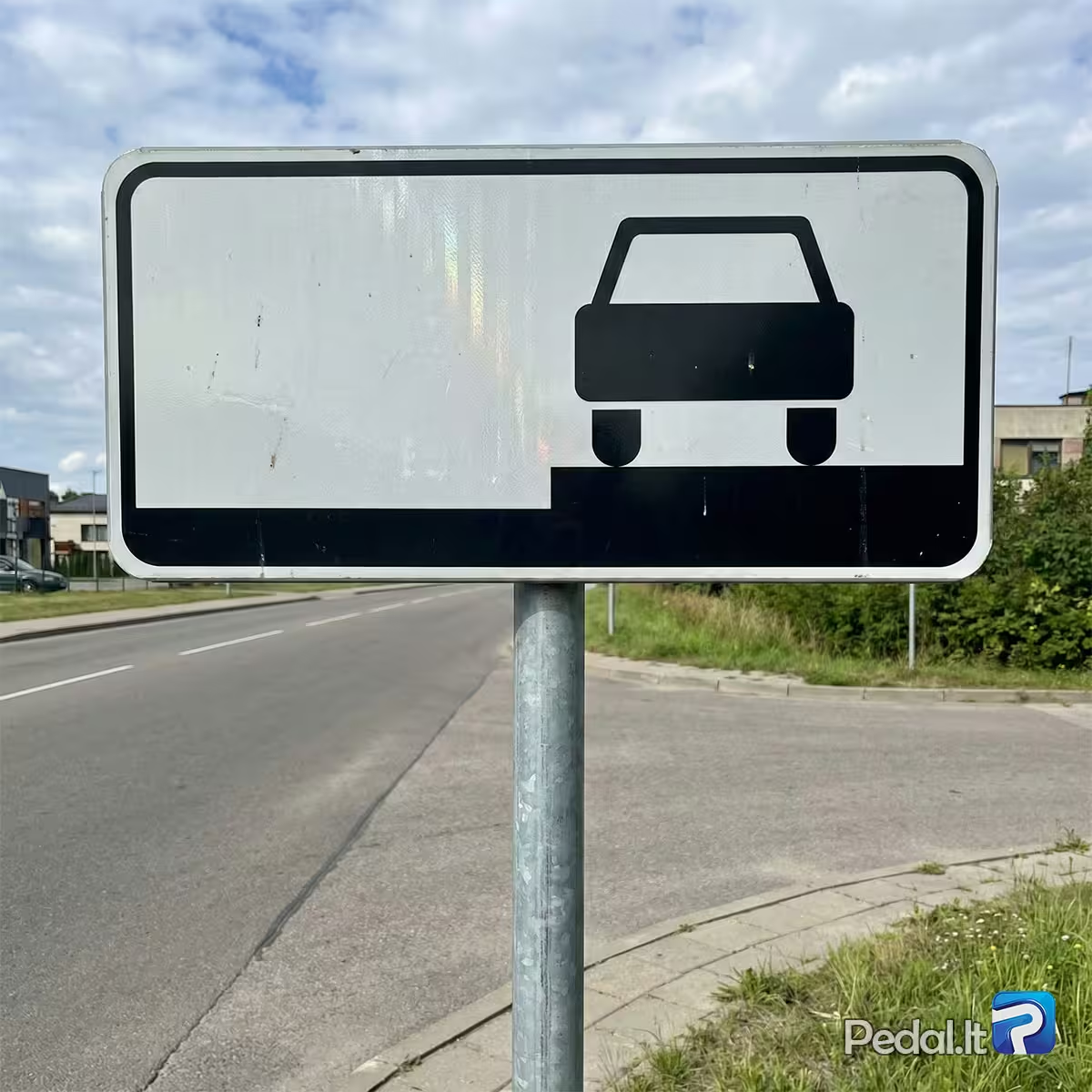
Which vehicles are permitted to park on the pavement according to this road sign?
RTR Annex 1. 832 — "Parking Method". Parking is permitted only as shown. Only motor vehicles with a maximum permissible weight not exceeding 3.5 tonnes, including such vehicles when combined with a trailer, may be parked here. Vehicles must be parked along the edge of the pavement closest to the carriageway.
1. Motorcycles.
2. Passenger cars.
3. Vehicles whose maximum permissible weight does not exceed 3.5 tonnes.
4. Vehicles towing a trailer with a maximum permissible weight over 3.5 tonnes.
After a prolonged dry and hot spell, it begins to rain. As a result, the road surface may become:
During an extended dry period the road surface accumulates rubber deposits and other dust. When rain first falls, these deposits mix with the water and create a sticky, unusually slippery surface. Exercise extra caution, especially at junctions, bends and roundabouts, and allow about twice the normal stopping distance. If the rain continues for a longer time, the slippery residue will gradually be washed to the sides of the road with the runoff; afterwards the road will be slippery only because of the moisture. JB
1. Become unusually slippery and sticky.
2. Become non-slippery.
3. Become rougher.
4. The road surface will remain unchanged.
Outside built-up areas, a warning triangle must be placed behind a vehicle at a distance of no less than:
92. If the hazard warning lights are not installed or are defective, and an emergency stop is required where stopping or parking is prohibited, after an accident, or if the stopped vehicle would be visible to other road users from less than 100 metres, the driver of a motor vehicle (excluding motor mopeds and motorcycles without a trailer), a tractor, or a self-propelled machine must immediately place an emergency stop sign on the carriageway side opposite the direction of travel: within built-up areas, at least 25 m behind the stopped vehicle, and outside built-up areas, at least 50 m behind it. If at least one rear position lamp is defective and the hazard warning lights do not work while driving in the dark or in poor visibility, an emergency stop sign must be attached to the rear of the vehicle to continue driving.
1. 20 m.
2. 30 m.
3. 40 m.
4. 50 m.
What is the maximum permitted speed on a highway from November through March for a goods vehicle with a maximum permissible mass of 3.5 tonnes?
RTR 131.1: Maximum speed limits are as follows — on motorways: 130 km/h from April to October and 110 km/h from November to March; on highways: 120 km/h from April to October and 110 km/h from November to March; on roads with asphalt or concrete pavement: 90 km/h; on other roads: 70 km/h.
1. 90 km/h
2. 110 km/h
3. 120 km/h
.avif)
Which vehicle will pass through the intersection first? (The green traffic light applies to the red car.)
RTR 163. When driving in the direction indicated by an arrow displayed in the supplementary section of a traffic light together with an amber or red signal, the driver must yield to road users coming from other directions who have a traffic signal permitting them to proceed, except as provided in Paragraph 163-1. 163-1. When making a U-turn at an intersection controlled by traffic lights, the driver must yield to road users from other directions who are permitted to proceed by a traffic signal. JB
1. The red car will pass the intersection first.
2. The black car will pass the intersection first.
Which of the following correctly describes stopping distance?
Stopping distance is the distance a vehicle travels from the moment the driver notices an obstruction until the vehicle comes to a complete stop. Braking distance is the distance the vehicle travels from the moment the brakes are fully applied until it stops. Reaction distance is the distance the vehicle travels from the moment the driver detects an obstruction until the driver begins to apply the brakes.
1. The distance a vehicle travels from the moment the driver detects an obstacle until the vehicle comes to a complete stop.
2. The distance a vehicle travels until the braking force is transmitted to the wheels.
3. The distance a vehicle travels from the moment braking begins until the vehicle comes to a complete stop.
When leaving an intersection, the driver must not enter:
When making a left or right turn, or when turning around from a single lane onto a multi-lane road, the driver may choose which lane to enter unless road signs ('Traffic Directions at an Intersection') indicate otherwise. RTR XIII. Moving Off and Manoeuvring (para 99–116) 108. The turning manoeuvre must be performed so that the vehicle does not enter or end up in a lane intended for oncoming traffic when entering or leaving the intersection. If a turn or U‑turn is made from a single lane, drivers may select any lane of the carriageway to enter. If turns are permitted from multiple lanes, drivers must execute the manoeuvre without obstructing vehicles turning from adjacent lanes.
1. The left-hand lane.
2. The right-hand lane, provided the left-hand lane is clear.
3. A lane used by oncoming traffic.
When driving, you must yield to pedestrians when they:
RTR 30. When approaching an uncontrolled pedestrian crossing, a driver must slow down or stop before the crossing to yield to pedestrians who have stepped into any lane, are moving within any lane, or are standing immediately before a lane (at the edge of the roadway) waiting for the opportunity to step into that lane in the direction of the vehicle’s travel or into any lane on a road with one lane in each direction. Drivers must take extra precautions during hours of darkness, when visibility is poor, or whenever a pedestrian crossing is not clearly visible from the driver’s position, and must ensure there are no pedestrians who should be given way at the crossing.
1. Are already on a pedestrian crossing.
2. Are stepping onto a pedestrian crossing.
3. Are standing at the edge of the roadway before a pedestrian crossing and waiting for the opportunity to step onto it.
Which vehicles are permitted to cross a level crossing when the red traffic light is illuminated?
Personnel of special services decide for themselves when it is safe to cross a level crossing. (RTR 186.) Drivers of special vehicles authorized to use blue and red (or blue only) flashing lights and audible warning signals may activate these only when necessary to save life, protect health or property, maintain public order and traffic safety, detain persons suspected of committing offences, or when escorting or accompanying official delegations and protected persons. Drivers of special vehicles operating with blue and red (or blue only) lights (visible over a 360° angle) and audible signals may disregard the requirements of Chapters V, X, XIII, XIV, XV, XVI, XVII, XVIII, XIX, XXI, XXI1, and XXII and Annexes 1–3 of the Rules and claim the right-of-way, provided they do not endanger traffic safety and only after ensuring that other road users yield. The right-of-way also applies to drivers of vehicles escorted by such special vehicles.
1. Special-service vehicles traveling with blue and red (or blue only) flashing lights and audible warning signals activated.
2. Vehicles displaying amber (orange) flashing lights.
3. Road maintenance or repair vehicles.
4. Passage is prohibited for all vehicles.
.avif)
Which driver must give way?
157. When turning left or making a U-turn, the driver must give way to oncoming vehicles on roads of equal priority that are proceeding straight ahead or turning right; at an intersection where overtaking is permitted, the driver must also give way to overtaking vehicles.
1. Driver of the passenger car.
2. The cyclist.
.avif)
Which directions is the vehicle permitted to take?
Only directions 1 and 3 are permitted in this situation. At the junction, turning (direction 1) and proceeding straight ahead (direction 3) are allowed. The 'No right turn' sign prohibits the turn into direction 4; the sign applies to the carriageway at the intersection where it is installed. Direction 2 is not permitted because that road leads onto a pavement. Road sign 322 — No right turn. Applies at the intersection before which the sign is placed. Does not apply to public service vehicles. JB
1. Directions 1 and 2
2. Directions 1 and 3
3. Directions 3 and 4
4. Directions 1, 2 and 3
1 of 30 Task
Time left: 00:00:00
1
2
3
4
5
6
7
8
9
10
11
12
13
14
15
16
17
18
19
20
21
22
23
24
25
26
27
28
29
30